Expanding on last month's commentary:
Last month, I discussed the extraordinary pace of capital spending on artificial intelligence and the market's growing tendency to treat that spending as if the potential returns were undeniable. The underlying assumption has been that if companies like Alphabet (Google), Microsoft, Amazon, and Oracle are willing to spend trillions of dollars on chips, data centers, networking, and power infrastructure, the resulting economic returns must be achievable. That may ultimately prove true, but investors should focus on the issues that will determine when those returns arrive.[1]
A recent Bain & Company analysis frames the issue in a useful way. Bain estimates that annual spending on AI infrastructure could reach approximately $1.5 trillion by 2031 and argues that, if capital expenditures amount to roughly 25% of industry revenue, sustaining that level of spending would require an AI market approaching $6 trillion in annual revenue. Bain also estimates that consumer AI products and enterprise productivity applications together may account for only $1.2 trillion to $1.8 trillion of that amount, leaving a substantial gap that entirely new sources of economic value, not cost savings alone, would need to fill. [2]
That distinction matters. Productivity gains are valuable and likely durable in many settings, but they are not the same as the broad-based revenue creation required to support an infrastructure cycle of this size. The market has already done a reasonable job identifying the most obvious near-term beneficiaries of the AI buildout, particularly semiconductors, cloud platforms, and networking vendors. The harder question, posed by Bain and likely more important over time, is where the next layers of value creation will emerge and which companies will ultimately earn attractive returns on the capital now being deployed.
Bain points to several areas where AI may create new value, including AI-driven search and advertising, autonomous systems, "physical AI" tied to industrial and manufacturing applications, and new product development across sectors such as drug discovery, materials science, and scientific research. Those categories matter because they move the discussion beyond office productivity and into areas where AI could reshape large parts of the physical economy.
Bain notes that this perspective aligns with how major technology cycles typically develop. Early in the cycle, capital flows to enabling infrastructure. Later, the largest rewards often accrue to the companies that translate that infrastructure into indispensable products and services. The challenge for investors is that those later-stage winners are often less obvious at the outset than the companies selling the inputs required to build the system.
After the building boom, what comes next?:
One of the more underappreciated aspects of the AI infrastructure super cycle may be the industries that make the buildout operationally feasible, rather than the ones that get the most public attention. As AI data centers grow larger and more power-intensive, dependable access to electricity is becoming a key deployment constraint. Bain notes that leading-edge AI data centers are already approaching 1 gigawatt of power capacity, with many expected to approach 2 gigawatts by 2027 and much larger campuses emerging later in the decade.
Once data-center scale reaches that level, power is no longer a background input. It becomes a strategic variable. That is one reason there is growing interest in on-site and behind-the-meter power solutions for AI facilities. In practice, developers cannot wait indefinitely for grid upgrades, interconnection approvals, or utility buildouts if the economic value of new compute capacity justifies more direct solutions.
We believe that this has several investment implications. The obvious beneficiaries include turbine manufacturers, equipment suppliers, electrical-system providers, and companies involved in thermal management, power conditioning, and site-level energy infrastructure. However, the opportunity may extend more broadly to the companies that help integrate generation, storage, switching, controls, and resiliency into a functioning on-site power architecture. In an environment in which power availability can determine the timing of capacity deployment, these less visible parts of the infrastructure stack may matter more than investors currently appreciate.
On-site power systems have interested us for some time, and this emerging market extends beyond data centers to mission-critical facilities and industrial complexes. Emerging technologies to meet this need include cleantech innovations involving solid oxide fuel cells, solar, and small modular nuclear reactors. At Seven Summits Capital, we have historically tried to look through first-derivative beneficiaries of major technology innovations to second- and third-derivative beneficiaries. For example, we have had a relatively small, but broadly allocated, position in a non-U.S. company developing solid oxide fuel cells for several years. We continue to believe in this company's technology and business model, and are pleased that the AI buildout is creating a broader market for such innovation in sustainable onsite energy generation and storage solutions, not just compute hardware. As AI data center expansion broadens globally, and these data centers grow in size, resilient, modular, and potentially more efficient site-level power solutions become increasingly important given the capacity-constrained traditional power grid in many places.
Another area that may be easy to dismiss today but worth watching carefully over time is the eventual integration of quantum compute into the broader AI compute chain. This is another area where we have been very early investors. We made our first investments in pure-play quantum computing a little over two years ago. Quantum computing is not designed to replace classical computer technology. We share the view, about how quantum computing technologies will fit into AI compute ecosystems, of those who see quantum systems used in a hybrid environment to address optimization, simulation, materials science, and scientific-research workloads that complement advanced AI and high-performance computing systems. In this sense, quantum technology would act less as a replacement technology and more as another demand multiplier for parts of the broader AI and advanced-compute ecosystem.
Our ever-evolving thesis is that the AI buildout may produce a wider and more complex set of beneficiaries than the market currently recognizes. Part of our investment philosophy is to avoid the herd mentality I have seen over the last 30 years of my career, where investors chase yesterday's leaders instead of looking ahead for tomorrow's potential leaders. The first phase of the AI infrastructure cycle has undeniably captured investors' attention. This first phase has understandably centered on the most visible companies and the most immediate bottlenecks. The next phase, the one we are spending the most time thinking about, may increasingly reward companies that solve practical constraints around power, integration, specialized computing, and physical deployment.
A valuable lesson those of us who invested in the lead-up to the dot-com bubble's burst in 2000 took away was that a company's connection to an emerging technology's infrastructure super cycle does not automatically make it a compelling long-term investment. Today's AI infrastructure super cycle dwarfs that of the late 1990s. But the relevant questions remain familiar: whether the company has a durable competitive advantage, whether its product or service solves an economically meaningful problem, whether customers get a measurable return on their spending, and whether management can translate rising demand into sustainable returns on capital.
This is especially important in a cycle where infrastructure is being built ahead of fully proven end demand. Bain's analysis makes clear that enterprise productivity and consumer subscriptions, while meaningful, are unlikely, on their own, to fund the scale of investment underway. Applications and use cases that materially expand economic output must close the gap.
That leaves investors like Seven Summits Capital with a daunting challenge. First, we must identify where the buildout is likely to create durable demand, including in areas that may not be obvious at first glance. Second, we must distinguish between revenue growth driven by genuine value creation and revenue growth driven merely by temporary spending enthusiasm. That distinction will likely become more important as this cycle matures. We also cannot ignore the threat posed by low-cost "open source" AI compute models that may, over time, be entirely appropriate for the vast majority of AI use cases. As a result, low-cost, open-source models will likely emerge as a risk that could jeopardize the planned return on investment for companies spending every penny of their free cash flow, and more, to build data centers for so-called frontier AI labs such as OpenAI and Anthropic.
There is little question that the AI infrastructure super cycle is real, and it will likely prove to be one of the defining investment themes of the first half of the 21st century. However, we believe that the ultimate winners may not be limited to companies directly benefiting from building ever-larger data centers. Whether the returns ultimately justify the current scale of investment will depend on whether that spending produces new and lasting economic value.
Boom, bust, winners and losers:
JP Morgan Asset Management recently published a 50+ page report titled AI-conscious asset allocation: Portfolio construction in a capital investment boom. In this report, JP Morgan wrote about the spending by the hyperscaler companies, such as Microsoft, Google, and Amazon, on AI infrastructure: "The ability of these firms to 'stay in the game' longer could create the conditions for overinvestment in costly physical infrastructure that may have a hard time generating adequate returns. In prior capital investment cycles, expensive infrastructure that could not generate adequate returns ultimately passed through bankruptcy to new owners who were able to operate them successfully. Hyperscalers shift this dynamic. Their shareholders might end up regretting the vast capital expenditures undertaken in the pursuit of AI dominance, but their balance sheet strength dramatically reduces the risk of default and reorganization." This view closely reflects our view that this capital-spending supercycle, unlike typical booms in the past, is unlikely to result in many of those companies' investment spending ending up as roadkill. However, that does not mean the public markets will not exact a harsh toll on companies that make trillion-dollar capital investment mistakes, as measured by a return on invested capital that falls far short of expectations. [7]
Investors and the general public are just now beginning to hear about the challenges facing what is essentially a technological paradigm shift that is essentially designed to "rewire" both the global economy and virtually everything individuals interface with on a daily basis. JP Morgan, in the aforementioned paper, wrote about some of the challenges that are now being widely discussed: "Already the physical infrastructure of AI is a leading cause of concern. A recent national poll found that roughly seven in 10 Americans would oppose a data center near them, including nearly half who are strongly opposed. The physical scarcity of key power and water resources in critical locations is becoming a major barrier to data center construction, with estimates that local opposition stalled or blocked more than USD 150 billion of projects in 2025 alone. This trend appears to be accelerating in 2026."
Having navigated the 1997-2000 dot.com era and the collapse of many of the "pick and shovel" companies of that infrastructure boom, I find this AI boom both exciting, given the technology's transformational nature, and much more challenging because of the sheer size and speed of the spending. Because we share JP Morgan Asset Management's assessment that we are not likely to see a typical boom/bust cycle because most of the spending is being funded by the largest and most profitable companies the world has ever seen, we see more of an eventual binge/hangover situation unfolding, with the hangover taking quite a long time to shake off.
The earnings mirage:
This hangover idea is supported by an accounting reality that is lost in the focus on the spending frenzy. However, this spending frenzy has a less exciting flipside.
The AI buildout can temporarily raise aggregate S&P 500 reported earnings relative to underlying cash economics because suppliers record current revenue and profit while customers capitalize the equipment and recognize only gradual depreciation. That is not an accounting error; it is a timing and aggregation effect that becomes unusually powerful when spending is growing rapidly.
In the current AI infrastructure supercycle, hyperscalers such as Google (GOOGL) and Microsoft (MSFT) buy chips, networking gear, data-center equipment, power infrastructure, and related services with free cash flow and debt. Chipmakers, hardware vendors, industrial firms, utilities, and data-center-related businesses recognize revenue and, where margins permit, profit when they deliver those products or services.
The buyers instead record qualifying equipment as a long-lived asset. Cash leaves immediately and reduces FCF, but the cost reaches the income statement incrementally through depreciation once the asset is placed in service. This capital-investment accounting treatment for building data centers spreads these costs over many years, while semiconductor and other data-center equipment sales recognize revenue and associated profits upfront, when delivered.
Because of this accounting mismatch, as spending ramps up, buyers' and sellers' revenues and profits in the AI infrastructure ecosystem are boosted by seemingly insatiable demand for sellers and deferred expenses for buyers. This dynamic between sellers and buyers at the individual company level bolsters reported profits, increasing the P/E denominator (earnings) and lowering the multiple even as the company's market value and share price rise.
At the broad market level, one popular way investors assess whether the market is under- or overvalued in aggregate is by looking at the index's earnings multiple, which divides the index's aggregate earnings by the market's price. As discussed in last month's commentary, S&P 500 companies whose businesses are meaningfully leveraged to the AI infrastructure build-out currently account for roughly 47% of the S&P 500's aggregate market cap. This means the current AI spending boom significantly affects the reported earnings and multiple-derived valuation metrics of the overall market cap-weighted index. Given the spending cycle-driven dynamic discussed above, it is clear that this dynamic translates into the AI sellers, such as chip makers Nvidia and Micron, recognizing revenues and profits on the front end of the spending cycle, and the buyers, such as Google, Microsoft, and Meta, deferring large amounts of their associated expenses over several years or longer. This dynamic is impacting the aggregate reported earnings and earnings growth of the S&P 500 as a whole in a meaningful way.
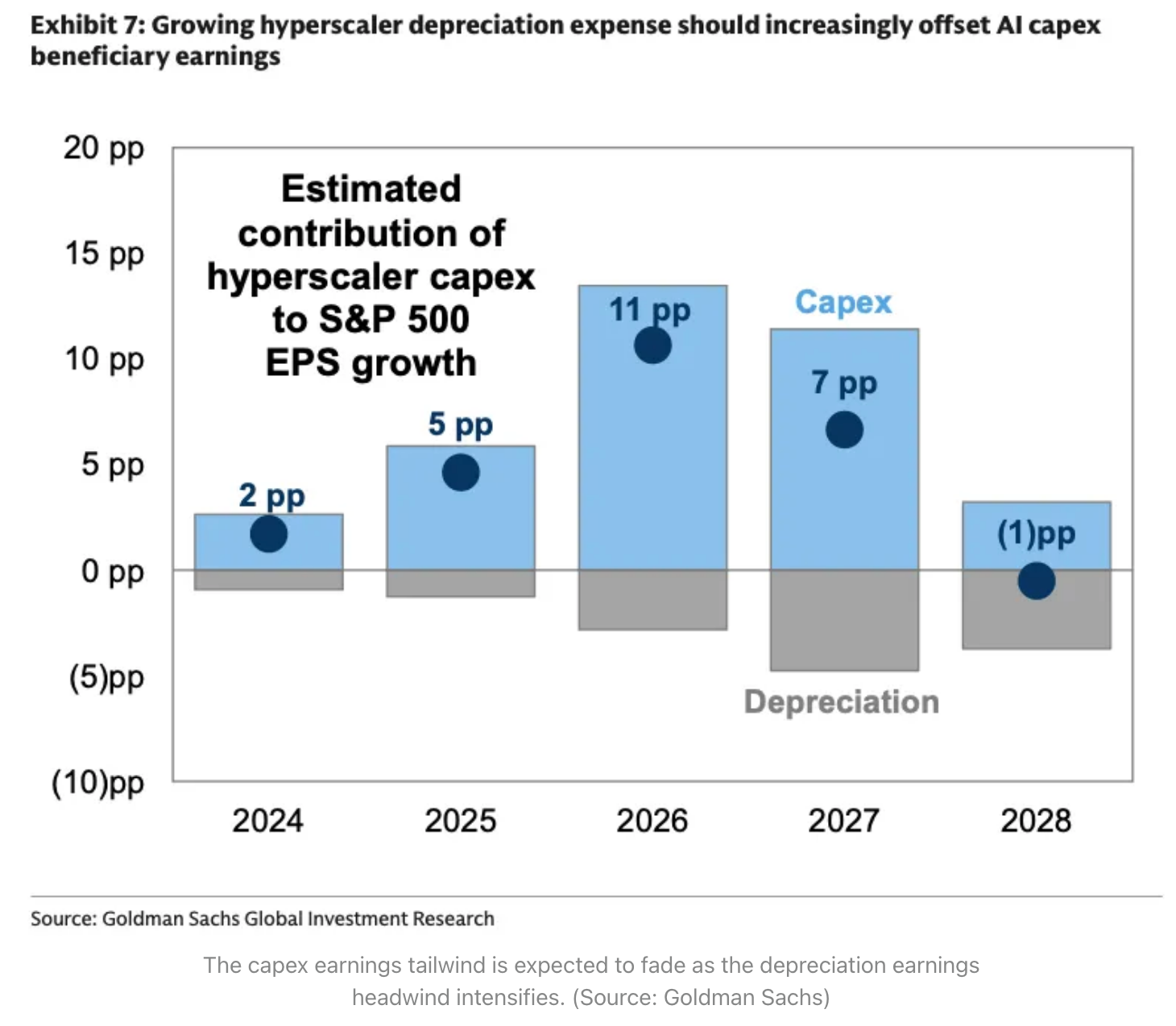
This dynamic is strongest when capital expenditures accelerate, as they have over the last three years. Suppliers (sellers) recognize earnings on the largest, newest spending wave while buyers can push the spending impact on earnings into future years through depreciation. In 2026, Goldman Sachs estimates hyperscalers will spend about $800 billion on capex-up 94% from 2025-and that this spending will account for almost half of S&P 500 EPS growth through the resulting income at AI infrastructure companies. Goldman Sachs Research stresses that AI investment will drive almost half of S&P 500 EPS growth in 2026. The largest US hyperscaler companies are on track to spend around $800 billion on capital expenditures this year, an increase of 94% over 2025. That money is flowing through the earnings of chipmakers, tech hardware suppliers, industrial firms, and utilities. Investors have been in awe of recent earnings growth rates at both the company level and in the S&P 500, driven by the current AI spending cycle.[3]
Lance Roberts published an article on Investing.com on July 24, 2026, titled AI Capex Depreciation Risk Is the Catch to Record Earnings. This article offers a compelling analysis of the dynamic I am highlighting. In this article, he quotes Todd Castagno at Morgan Stanley, who calls the current corporate earnings environment "a golden window where everybody looks good." Lance Roberts writes, "He's right. Revenues and margins look strong among chipmakers and the companies buying the chips at the same time, which is exactly the kind of broad, simultaneous strength that convinces investors a cycle is durable rather than borrowed from the future. Make no mistake, there's nothing improper here. This is how companies book capital assets. What's different this cycle is the sheer scale of the spending, and the eventual AI capex depreciation is being overlooked. Here's the problem with the everything-is-fine read. The spending is enormous, and it shows up in cash long before it shows up in earnings. The five biggest hyperscalers, Alphabet (GOOGL), Amazon (AMZN), Meta (META), Microsoft (MSFT), and Oracle (ORCL), spent about $412 billion on capex in 2025. For 2026, the estimates run to roughly $760 billion. Yet the AI capex depreciation and amortization that those companies expect to recognize against all that spending in 2026 is only about $211 billion." [5]
AI-related infrastructure investment is causing a temporary positive wedge between S&P 500 accounting earnings and free cash flow. Supplier profits linked to current AI capex are recognized immediately, while purchasers capitalize most infrastructure spending and recognize costs gradually through depreciation. Consequently, during a period of accelerating AI capex, reported index earnings and the apparent P/E may overstate normalized earnings power and understate the economic reinvestment needed to sustain that earnings base.
In my former life as a commercial banking credit analyst and eventually an equity analyst, I was trained to reconcile cash flow versus reported accounting profits and losses. There is almost always a meaningful discrepancy; however, accounting treatment of cash outlays relative to depreciation will inherently reconcile over time. What boosts accounting profits in the near term will do the opposite over time. When current AI capital expenditure growth eventually slows, supplier revenue growth should decelerate while accumulated depreciation keeps rising for buyers, putting pressure on reported profits. We are taught that depreciation is a non-cash expense, and that is true in the year depreciation expense is recognized, but depreciation reflects prior-period expenditures funded through cash flow or debt; it was just not recognized then.
Goldman Sachs estimates that hyperscaler depreciation could subtract about 5 percentage points from S&P 500 earnings growth in 2027, offsetting nearly half of the estimated 11-point earnings-growth benefit from continuing capex expected for 2026. The following Goldman Sachs chart, republished by Sam Ro CFA in his blog titled The AI earnings headwind and accounting headache that's set to intensify, illustrates the boost to S&P 500 earnings growth coming from the accounting dynamic being created by the recent boom in AI infrastructure spending and how that boost is expected to peak in 2026 and subside rather quickly over the next two years. [7]