American capitalism has been the envy of the world for the last 150 years, and for good reason. American entrepreneurs discovered and commercialized electricity, oil and, more importantly, oil refining, mass-produced automobiles, the airplane and commercial air travel, insulin, antibiotics, and the polio vaccine, the semiconductor and personal computer, the internet and email, the smartphone and social media, and of course, AI (artificial intelligence).
AI, and what will likely be the next truly paradigm-shattering innovation, quantum computing, will most likely be to the 21st century what distributed electricity, the automobile, oil refining, and the semiconductor were to the 20th century. Just like a person born in 1927 couldn't foresee how much life would change over the course of their life as a result of the ingenuity of American capitalism, it is equally, or maybe even more, impossible for someone living today to imagine what today's technological advances will enable, even over the next ten to fifteen years. Since the invention of the semiconductor, we have become accustomed to exponential technological advances. Gordon Moore, the Intel scientist who predicted in 1975 that the speed and data capacity of a semiconductor would double every two years, was correct; that doubling became known as Moore's Law.
Today, AI is advancing much faster. Nick Damoulakis, an AI strategist and CEO of Orases, recently wrote, "The rule that governed the entire computing industry for decades doubles chip processing power every 24 to 26 months. AI capability is running at 3 to 5x that pace."
In the late 1990s, as a technology stock analyst, I knew, as many people did, that the internet would dramatically change the world, but we truly did not know how long it would take and ultimately who would be the big winners and the big losers. At the time, it appeared to be a good bet that Yahoo, AOL, Cisco Systems, and EMC would be the big winners over the upcoming 10-20 years of the internet age that we were entering. Ten years later, only Cisco Systems was left standing as an independent company, and the dominant companies that emerged to dominate the internet age were Google, Apple, Netflix, and Amazon.
Today we see the AI spending boom creating several multi-trillion-dollar companies that the market and investors are taking for granted that these mega-cap companies and their management teams will execute flawlessly and remain on top. This complacency is occurring in the face of a highly uncertain and increasingly competitive environment.
The Investment Theme Ponzi
Over the last decade, I have witnessed the noteworthy outperformance of what have become known as mega-cap companies. In particular, equity markets have been propelled higher over this period by mega-cap technology and communications sector stocks. Investors have become accustomed to acronyms/labels such as FANG and MAG 7. These labels have become part of the financial lexicon worldwide. I have observed that the MAG 7 stocks as a group, which includes META, MSFT, GOOGL, AAPL, AMZN, NVDA, and TSLA, began to falter starting in the second half of 2025, given that they have lagged behind the equal-weighted market average return, international equities, and small caps over the last year. Beginning in June, it was becoming evident to me that the market was searching, and not finding, a new theme to replace MAG 7. With Anthropic, one of the leading frontier AI lab companies, likely coming public this fall, following SpaceX's (SPCX) public debut, MANGOS may be that new theme, standing for Meta, Anthropic, Nvidia, Google, OpenAI, and SpaceX. According to Google Gemini, MANGO was first used by Bank of America securities Analyst Vivek Arya and has been expanded to MANGOS once the SpaceX (SPCX) IPO became a certainty.
I see these labels as nothing more than hype-branding promoted by the likes of Morgan Stanley, Goldman Sachs, and Merrill Lynch (Bank of America). I believe that our markets have become addicted to themes. Themes induce FOMO (Fear of Missing Out) and stock-price momentum for associated stocks. Seven Summits Capital relies mostly on "bottom-up" portfolio construction, meaning that we work to identify mispriced securities and underappreciated businesses. I see the prevalence of themes such as FANG and MAG 7 as dumbing down investing and, at their peak, suck the oxygen out of the rest of the market for a period of time. These promoted investing themes are a product of a momentum driven market environment and each new theme forces a rotation out of the old theme and keeps the party going.
Grocery Store Mangos Notoriously Look Good, But Taste Bad
35 years ago, I was a commercial banking officer working with middle-market businesses in Pennsylvania. Many of my largest clients were real estate developers. After a painful real estate recession from 1989-1990, banks significantly tightened their underwriting standards for real estate developers. One of the biggest underwriting changes was the unwillingness to finance any material "Spec" construction. Spec construction was the development and building of improved real estate without committed buyers/lessees.
I see many parallels between real estate project underwriting and what is happening between AI lab companies such as OpenAI and Anthropic, and hyperscalers/neo cloud companies such as Oracle, Microsoft, Meta, and CoreWeave.
Hyperscalers/neo cloud companies are plowing hundreds of billions of dollars into building spec data centers and justifying doing so based upon what are essentially "compute leases" with the AI Lab companies, who are committing to paying many hundreds of billions of dollars per year in the early years after a data center comes online. These AI lab companies currently have annual revenues that are just a fraction of what they will need within the next 1-3 years to meet their lease obligations with the hyperscalers and neocloud companies.
Barron's published an article written by Al Root on August 27th titled, Is the AI Capex Bubble About to Burst? What 250 Years of Market History Tell Us. This Barron's article explored the current AI investment boom and how it compares to other historical infrastructure spending booms. The author attempts to extrapolate from historical data how much longer this spending can continue before it eventually ends badly. Below is the article's explanation of why the boom has a long way to go:
"Historically, these cycles have followed enough of a pattern to consider where artificial intelligence falls in the cycle. One could be dubbed the rule of 25, for the amount of total spending the U.S. has been able to digest during transformational booms as a percentage of the overall economy. At the start of the railroad boom in the 1860s, for instance, U.S. gross domestic product was about $10 billion a year, according to the National Bureau of Economic Research, while rail spending eventually totaled $2.5 billion before the 1873 panic arrived. Similarly, about $1.5 trillion was spent building internet infrastructure in the late 1990s, while the U.S. economy was only $6 trillion at the time. The same holds for the industrial and electrification buildout of the 1920s."
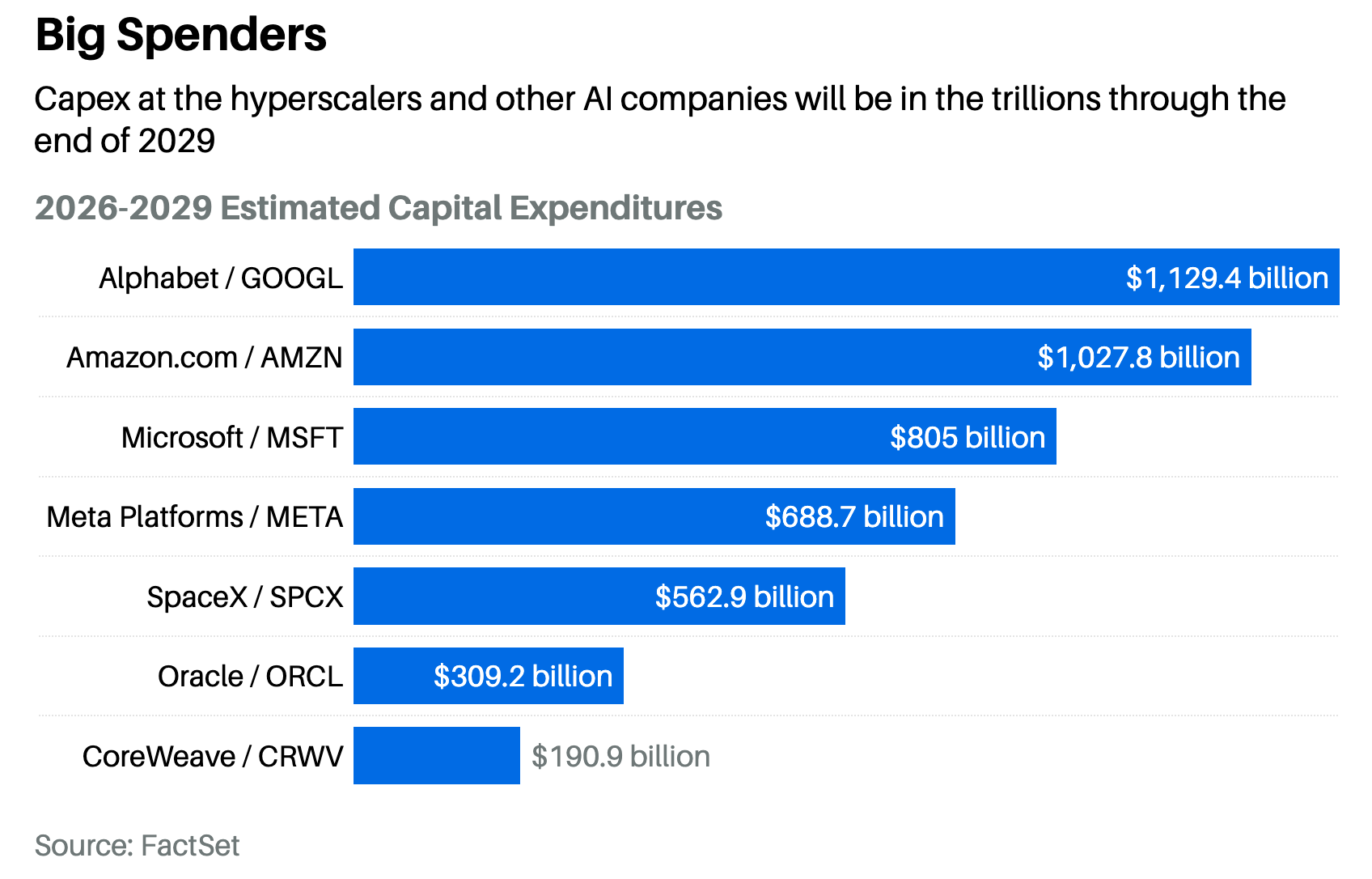
"Using that standard, it's possible to generate a top-down estimate of how much can be spent on AI before the economy is ready to collapse under its own weight. With U.S. GDP at roughly $30 trillion, the danger zone sits at about $7.5 trillion, or an additional $5 trillion to $6 trillion in domestic AI spending. Hyperscalers are projected to spend $3.7 trillion globally through 2029, and they aren't the only ones, with Oracle, SpaceX, Anthropic, and OpenAI, among others, building, too. At this rate, AI spending won't trip the rule of 25 until the early 2030s, six or seven years into the boom."
I strongly believe that history should never be ignored, but it is always tempting to try to fit current events neatly into a historical analog. As an observer, this exercise is intellectually enticing, but as an investor, these historical analogs are notoriously hard to speculate on with great precision when it comes to timing.. The current AI capital investment cycle may resemble past cycles, but markets are not entirely mechanical or entirely behavioral; markets are a combination of both. This combination makes attempting to precisely forecast markets extremely difficult, if not impossible.
Looking at the equity market in 2026 and the AI investment theme, I see an equity market that is nearly 50% leveraged to a predictable continuation of massive AI infrastructure investment and a business environment that enables a rapid adoption of AI by the broad economy to create a profitable business model for the AI lab companies such as OpenAI, Anthropic, and others.
From the aforementioned August 27th Barron's article, the current and anticipated spending by hyperscalers and neocloud companies is mind-boggling in absolute terms:
As an investment manager, I am naturally concerned about the financial realities that have yet to be stress-tested in relation to the AI infrastructure boom. But being concerned doesn't mean I can run and hide. I must understand which areas of the market are most exposed to these spec financing risks. The easiest place to start is the most heavily owned investment allocation, the S&P 500. See the illustration below: